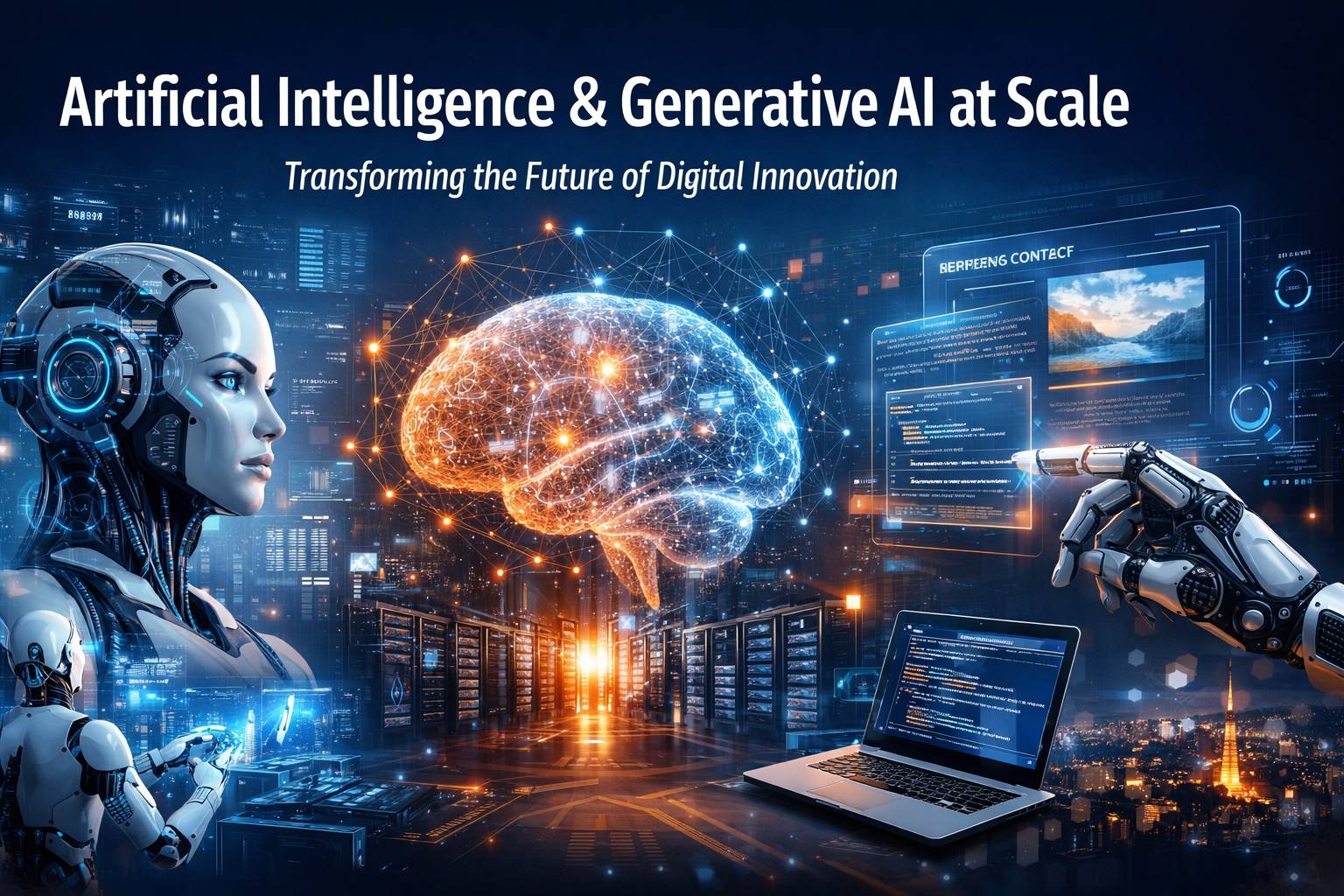
Artificial Intelligence (AI) and Generative AI at scale are redefining how businesses, governments, and individuals interact with technology in 2026. What began as experimental machine learning models has now evolved into enterprise-grade systems capable of generating text, images, code, and even complex decision-making frameworks. Companies such as OpenAI, Google, and Microsoft are leading this transformation by embedding AI deeply into cloud infrastructure, productivity tools, and consumer applications.
At the core of this revolution is Generative AI, powered by large language models (LLMs) and multimodal systems that can process and generate diverse forms of data. Unlike traditional AI, which focuses on prediction and classification, Generative AI enables creation—producing human-like text, realistic images, synthetic data, and even software code. This shift is enabling organizations to automate content creation, enhance customer experiences, and accelerate product development cycles. Tools like ChatGPT and Gemini exemplify how AI is becoming a daily productivity companion.
Scaling AI is the defining challenge and opportunity of this era. Enterprises are moving from pilot projects to full-scale deployment, leveraging cloud platforms such as Amazon Web Services and Microsoft Azure to manage massive datasets and computational requirements. AI infrastructure, including GPUs and specialized chips, is experiencing unprecedented demand, fueling investments in data centers and edge computing capabilities. This large-scale deployment allows businesses to deliver real-time insights, hyper-personalized services, and intelligent automation across operations.
The impact of AI at scale spans multiple industries. In healthcare, AI is accelerating drug discovery and enabling predictive diagnostics. In finance, it enhances fraud detection and algorithmic trading. Retailers use AI to optimize supply chains and personalize customer journeys, while manufacturing sectors rely on AI-driven automation to improve efficiency and reduce downtime. Generative AI, in particular, is transforming creative industries by enabling rapid content generation for marketing, design, and entertainment.
However, the rapid adoption of AI also raises critical challenges. Issues related to data privacy, model bias, ethical AI use, and regulatory compliance are becoming increasingly important. Governments and organizations are working to establish frameworks for responsible AI deployment, ensuring transparency, fairness, and accountability. As AI systems become more autonomous, the need for robust governance and AI security solutions continues to grow.
Looking ahead, Artificial Intelligence and Generative AI at scale will serve as the backbone of the digital economy. The convergence of AI with emerging technologies such as edge computing, 5G, and quantum computing will unlock new possibilities, from real-time intelligent systems to fully autonomous digital ecosystems. Businesses that successfully adopt and scale AI will gain a significant competitive advantage, making AI not just a technology trend, but a strategic imperative for the future.
 Sneha S
  admin
admin